

More than a new name: how the Master’s programme in Sustainable Maritime Engineering came to life
What happens when 75 years of maritime engineering education meet the challenges of a rapidly changing industry? The answer is Sustainable Maritime Engineering – an international Master’s programme developed together with industry to prepare the next generation of maritime engineers.
Around 400 applications from 20 countries arrived before the first lecture had even taken place.
When the Master’s programme in Sustainable Maritime Engineering, or SME, welcomed its first students in October 2025, the strong response showed that the programme addressed a real international demand.
Its development had started several years earlier with one central question: “What should maritime engineers be able to do ten years from now?”
A changing industry needs new skills
Maritime engineering has a long tradition at the University of Rostock. Academic shipbuilding education in the city dates back to 1950, when the University established its Faculty of Shipbuilding to meet the growing need for qualified engineers.
Today, the maritime sector is transforming again. Shipping must reduce its environmental impact. Offshore renewable energy is expanding. Autonomous systems, artificial intelligence, digital engineering and underwater robotics are changing how marine technology is designed, built and operated.
These developments create new opportunities, along with a growing demand for engineers who can connect different disciplines. Modern maritime projects require technical expertise, systems thinking, teamwork and the ability to adapt to emerging technologies.
For the initiators of SME, updating a few modules would not have been enough. The entire programme needed a new structure and a broader perspective.
Four years of development
Sustainable Maritime Engineering grew out of a four-year development process involving the University of Rostock, maritime companies, research institutions and partners from the Ocean Technology Campus Rostock.
Industry and research were involved from an early stage. In two intensive workshops, representatives from the maritime sector helped define the programme’s direction.
The discussions focused on the future:
Which technologies will shape the sector? Which skills will graduates need? How can sustainability become a guiding principle across different engineering fields? How much freedom should students have when creating their academic profile?
The answers formed the foundation of SME.
This close cooperation also helped connect academic education with professional practice. Students now study within a programme shaped together with organisations developing new ships, offshore systems, underwater technologies and digital solutions.
Designed for individual paths
SME is an international, English-taught Master’s programme with three study tracks:
Naval Architecture, Ocean Engineering and Underwater Technologies.
More than 50 modules allow students to develop an individual focus. Subjects include green shipping, renewable energy systems, climate-neutral fuels, autonomous vehicles, hydroacoustics, machine learning and underwater robotics.
This flexibility reflects the reality of the maritime sector. Future challenges rarely fit into a single discipline.
A student interested in ship design may also explore sustainable propulsion or autonomous navigation. Someone focusing on ocean engineering can combine renewable energy with data-based methods. Others may specialise in underwater vehicles, acoustic systems or robotics.
Students can therefore build a profile that matches both their interests and their career plans.
Learning through real challenges
Project-based learning plays a central role in SME.
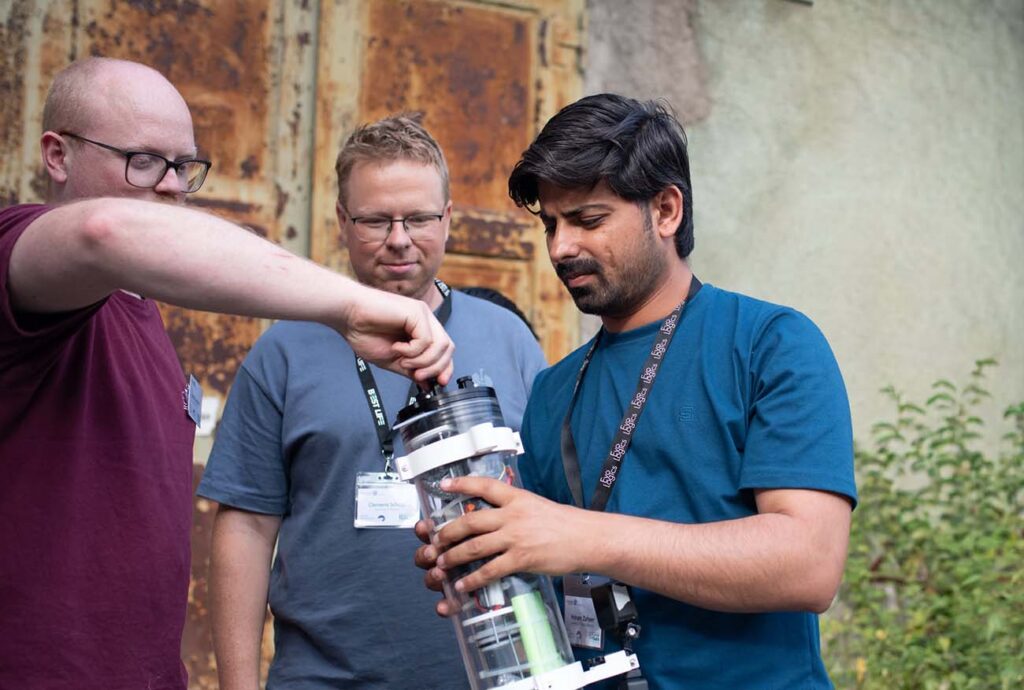
In interdisciplinary teams, students work on complex engineering tasks inspired by real applications. They learn how to combine technical knowledge, communicate across disciplines and develop solutions together.
Guest lecturers from industry, company visits and courses held at industrial sites provide further links to professional practice. Students gain early insights into current projects, technologies and working environments.
These experiences also show how broad a career in maritime engineering can be, ranging from ship design and offshore energy to research, software development, autonomous systems and underwater technology.
An international community
Around 400 prospective students from 20 countries applied for the first intake. 65 students joined the programme in October 2025.
SME became the Master’s programme with the highest number of new enrolments at the University of Rostock. It also became the largest maritime Master’s programme among German universities.
The programme continued to grow quickly. Another 85 students started in the summer semester of 2026. For the upcoming winter semester 2026/27, the programme has already received almost 260 applications, while enrolment for German students is still open.
Behind these figures are students with different academic backgrounds, experiences and perspectives. Together, they create an international learning environment from the first semester onwards.
This diversity is an important part of SME. Maritime challenges are global, and many solutions depend on cooperation across countries, cultures and disciplines.
Support beyond the classroom
Starting a Master’s degree abroad involves more than academic work. Students also need to settle into a new city, understand a different university system and build a social network.
SME therefore works closely with the University of Rostock’s International Office and Language Centre.
Welcome events and dedicated contact persons support students during their arrival and throughout their studies. German language courses can be included in the degree and help international students prepare for everyday life and future employment in the region.
Career events also bring students together with companies and research institutions. These contacts can lead to internships, Master’s theses, research projects and future jobs.
A new chapter for maritime engineering
Sustainable Maritime Engineering builds on 75 years of maritime education in Rostock while responding to the needs of a changing sector.
Students benefit from a programme developed around current technologies, practical experience, international collaboration and academic flexibility.
The first cohorts are already bringing this concept to life. Their growing international community shows how strongly the idea resonates with students around the world.
As technologies, professions and maritime challenges continue to evolve, SME will evolve with them. For every new student, the programme offers an opportunity to help shape that future.